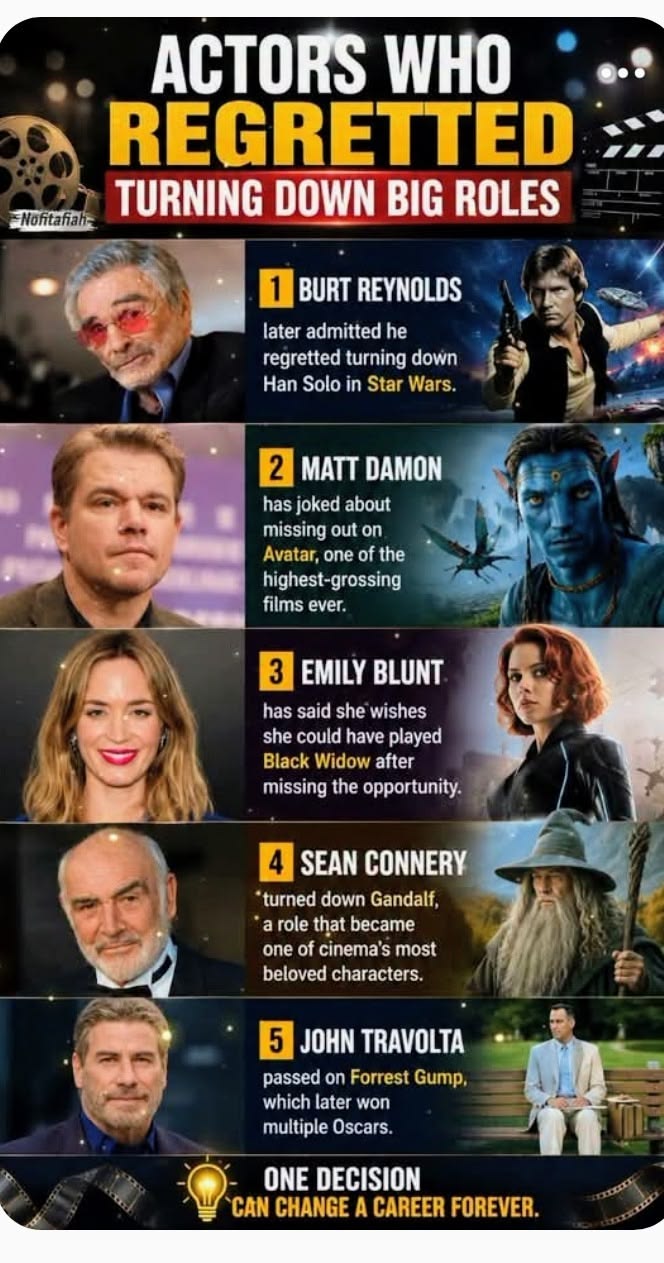
Hollywood is full of stories about actors who became famous after landing the perfect role. But there is another side to the entertainment industry: the performers who turned down opportunities that later became legendary.
Sometimes, an actor rejects a role because the script does not appeal to them. Other times, scheduling conflicts, salary disagreements, creative differences, or personal circumstances influence the decision. Occasionally, a performer simply cannot imagine how successful a film will become.
Looking back, some of these decisions seem surprising. A role that one actor declined may eventually become closely associated with another star, turning into an unforgettable performance or a major franchise.
Here are ten well-known casting stories that reveal how different Hollywood history might have looked if a few decisions had gone another way.
1. Will Smith and The Matrix
Will Smith was one of the biggest stars in Hollywood when he was offered the lead role of Neo in The Matrix.
Smith ultimately declined the part and instead appeared in Wild Wild West, released in 1999. The Neo role went to Keanu Reeves, whose performance became central to one of the most influential science-fiction franchises of its era.
The Matrix combined philosophical questions, groundbreaking visual effects, and innovative action sequences. Its famous bullet-time scenes helped change the way action films were made and marketed.
Smith later explained his decision in a humorous video in which he discussed how the filmmakers presented their ambitious concept. He has also acknowledged that Reeves was an excellent choice for the role.
The story is a reminder that rejecting one opportunity does not automatically mean making a bad career decision. Smith remained a major star, while Reeves found a role that became one of his signature performances.
2. Tom Selleck and Indiana Jones
Tom Selleck was reportedly selected to play Indiana Jones in Raiders of the Lost Ark, but his existing commitment to the television series Magnum, P.I. prevented him from taking the role.
Harrison Ford ultimately became the face of the adventurous archaeologist, appearing in multiple films across the franchise.
Ford’s combination of humour, toughness, and vulnerability helped make Indiana Jones one of cinema’s most recognisable characters. His portrayal became so closely associated with the role that it is difficult to imagine another actor playing the character.
Selleck, meanwhile, continued his successful television career and became famous for his work in Magnum, P.I. and later Blue Bloods.
This casting story illustrates how scheduling conflicts can influence film history. Even when an actor is interested in a role, existing professional commitments may make accepting it impossible.
3. Emily Blunt and Black Widow
Emily Blunt was considered for the role of Natasha Romanoff, also known as Black Widow, in the Marvel Cinematic Universe.
Blunt did not take the role, with scheduling commitments associated with Gulliver’s Travels commonly cited in accounts of the casting situation. Scarlett Johansson eventually portrayed Black Widow, making the character one of the most recognisable heroes in the franchise.
Johansson appeared in several Marvel films, including Iron Man 2, The Avengers, Captain America: The Winter Soldier, and her own standalone film, Black Widow.
Blunt went on to build an acclaimed career through projects such as Edge of Tomorrow, A Quiet Place, and Oppenheimer.
Her career demonstrates that missing out on one major franchise does not prevent an actor from finding other successful roles. Sometimes, the path not taken simply leads to different opportunities.
4. Sean Connery and Gandalf
Sean Connery, famous for playing James Bond, was reportedly offered the role of Gandalf in The Lord of the Rings trilogy.
Connery declined the opportunity. Ian McKellen eventually played Gandalf, delivering a performance that became one of the defining elements of the fantasy films.
The trilogy was an enormous cinematic achievement, earning critical acclaim and attracting audiences around the world. McKellen’s portrayal balanced wisdom, warmth, humour, and authority, making Gandalf memorable to longtime Tolkien fans and newcomers alike.
Connery reportedly explained that he did not understand the material well enough to accept the role. The story is often discussed as an example of a famous actor turning down a major opportunity without fully anticipating its eventual cultural impact.
However, Connery already had a remarkable career, and declining a project that does not appeal to an actor can be a reasonable choice.
5. Nicolas Cage and The Lord of the Rings
Nicolas Cage has spoken about declining major roles because he wanted to prioritise his family and avoid spending extended periods away from home.
He has been associated in interviews and entertainment coverage with opportunities involving major franchises, including The Lord of the Rings, although accounts of specific offers should be treated carefully unless directly confirmed.
Cage ultimately developed a distinctive career across action films, dramas, thrillers, and independent cinema. His work includes Face/Off, National Treasure, Leaving Las Vegas, and Pig.
His choices illustrate an important point: actors do not evaluate opportunities solely by potential earnings or box-office success. Family commitments, travel, personal interests, and the kind of career someone wants can all influence a decision.
For an actor with a long and varied filmography, turning down a blockbuster may simply create room for a different kind of project.
6. Gwyneth Paltrow and Titanic
Gwyneth Paltrow has been discussed in entertainment reporting as one of several actresses considered during the casting process for Titanic, although claims about exactly how far she progressed in the process vary.
Kate Winslet ultimately played Rose DeWitt Bukater opposite Leonardo DiCaprio in James Cameron’s 1997 romantic disaster film.
Titanic became one of the biggest cinematic successes of its time. Its emotional story, spectacular production, and memorable soundtrack helped it attract audiences across generations.
Winslet’s performance received an Academy Award nomination for Best Actress and helped establish her as an international star.
Paltrow also enjoyed major success, winning an Academy Award for Shakespeare in Love and later appearing in the Marvel Cinematic Universe as Pepper Potts.
This example shows why casting rumours and confirmed offers should not be treated as identical. Hollywood casting involves many stages, and not every actor discussed for a role receives a formal offer.
7. Matt Damon and Avatar
Matt Damon has publicly discussed being offered the lead role in James Cameron’s Avatar and turning it down because of his existing commitments.
Sam Worthington ultimately played Jake Sully in the 2009 science-fiction film.
Avatar became a landmark production because of its visual effects, motion-capture performances, and immersive depiction of the fictional world of Pandora. Its commercial success helped establish a major franchise.
Damon later explained that the decision involved more than the acting role itself, including the potential financial arrangement. However, he has continued to enjoy a successful career through projects such as The Martian, The Bourne franchise, and Oppenheimer.
His experience shows how difficult it can be to predict a film’s eventual impact. A project that looks like one opportunity among many can become a defining moment in cinematic history.
8. Leonardo DiCaprio and American Psycho
Leonardo DiCaprio was considered for the lead role of Patrick Bateman in American Psycho before Christian Bale ultimately played the character.
The film, released in 2000, became a cult favourite for its dark satire of consumer culture, corporate status, and toxic masculinity.
Bale’s unsettling performance helped make Patrick Bateman one of modern cinema’s most recognisable fictional characters. His ability to move between charm and menace gave the story much of its disturbing power.
DiCaprio continued pursuing a varied career, appearing in films such as Gangs of New York, The Aviator, The Departed, and The Wolf of Wall Street.
The casting story demonstrates that two talented actors can approach a character very differently. Sometimes, a role becomes memorable because the actor who eventually accepts it brings precisely the qualities the film requires.
9. John Travolta and Forrest Gump
John Travolta has been linked to the lead role in Forrest Gump, which eventually went to Tom Hanks.
Released in 1994, the film follows a man whose personal experiences intersect with major events in American history. Hanks’s performance earned him the Academy Award for Best Actor and helped turn the film into a cultural touchstone.
Travolta’s career followed a different path. He later experienced major success with Pulp Fiction, which helped revitalise his career during the 1990s.
The contrast is fascinating because both actors built memorable screen identities. Hanks became closely associated with emotionally accessible characters, while Travolta demonstrated an ability to move between musicals, thrillers, crime films, and comedy.
The lesson is not that Travolta made a terrible decision. Rather, it shows that Hollywood careers can remain successful even when an actor misses a role that becomes famous.
10. Michelle Pfeiffer and Clarice Starling
Michelle Pfeiffer has been associated with the casting discussions surrounding Clarice Starling in The Silence of the Lambs. Jodie Foster ultimately played the FBI trainee opposite Anthony Hopkins as Hannibal Lecter.
Foster’s performance became one of the defining elements of the psychological thriller. The film received widespread acclaim and won the five major Academy Awards, including Best Picture, Best Director, Best Actor, Best Actress, and Best Adapted Screenplay.
Pfeiffer, meanwhile, continued building a celebrated career with films such as Batman Returns, Dangerous Liaisons, and The Fabulous Baker Boys.
The story demonstrates that major roles are often shaped by an actor’s personal preferences and creative interests. A performer may decline a project because its themes, tone, or emotional demands do not feel right.
That decision can be entirely reasonable, even if the film later becomes a classic.
Why Do Actors Turn Down Major Movie Roles?
There are several reasons an actor might decline a potentially career-changing opportunity.
Scheduling conflicts: An existing film, television series, or theatre production may make it impossible to accept another role.
Creative differences: An actor may disagree with the script, director, characterisation, or proposed direction of a project.
Personal priorities: Family responsibilities and the desire for privacy can outweigh the benefits of a major production.
Career strategy: Some performers prefer independent films, challenging characters, or smaller projects rather than committing to a long-running franchise.
Uncertainty: Before a film is released, nobody can know with certainty whether it will become a classic, a commercial success, or a disappointment.
It is also worth remembering that some famous casting stories are based on rumours or complicated negotiations. A role being discussed with an actor is not necessarily the same as a formal offer being made and rejected.
Final Thoughts
The history of Hollywood is full of casting decisions that invite fascinating questions. What would The Matrix have looked like with Will Smith as Neo? Would Titanic have felt different with another leading actress? Could a different Gandalf have changed the atmosphere of The Lord of the Rings?
We will never know for certain, but these stories reveal how much an actor’s interpretation can shape a film.
At the same time, turning down a famous role does not automatically mean an actor made a mistake. Many performers have enjoyed extraordinary careers while choosing projects that better suited their personal lives or creative ambitions.
Sometimes, the role an actor rejects becomes another performer’s greatest achievement.
Which casting decision surprises you the most? Tell us in the comments which actor you think would have changed a famous film the most.
Leave a Reply